Domestic, semi-professional and industrial sewing machines: how to choose?
Quick summary
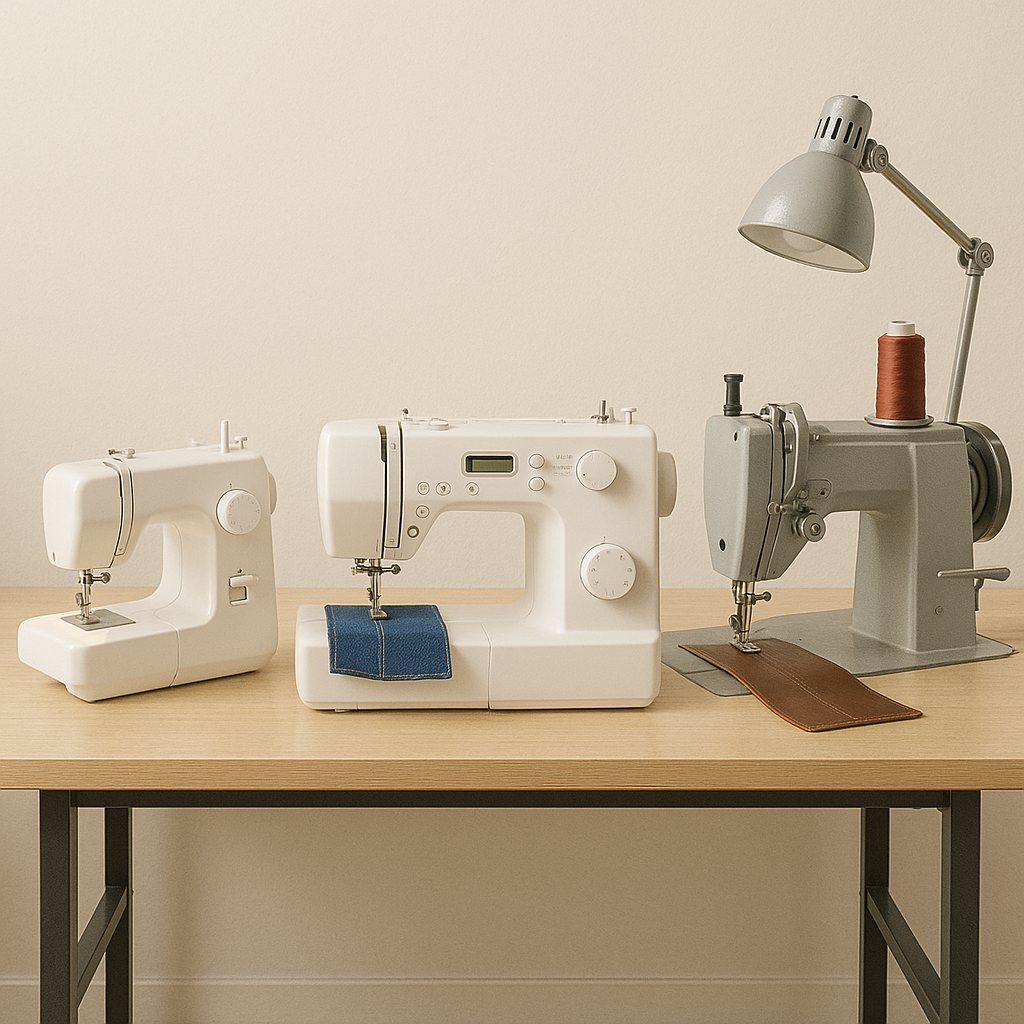
Domestic machines are perfect for beginners (many stitches, easy to move) but quickly show their limits on thick fabrics or in production.
Semi-professionals are more rigid and durable, ideal for starting a small workshop, but their real advantage over industrial ones remains portability.
Industrial machines are the reference for speed, precision, and continuous production.
.
👉 My advice: start simple if you're beginning; if you are opening a workshop, invest directly in the industrial machine.
Domestic, semi-professional and industrial sewing machines: how to choose?
At JD Dépannage, it's a family story: my father started repairing very young, then selling. When arriving in France, we naturally continued the activity.
We test all the models we sell, from family machines to industrial ones. I am not a great seamstress, but I have solid field experience thanks to tests, repairs, and customer feedback.
Domestic machines: versatile and accessible
Advantages: wide variety of stitches, compact and mobile format; some models combine classic sewing + embroidery.
Problems seen in workshops: incorrect threading, lack of cleaning, badly positioned needle, trying materials too thick for the machine.
Typical case: during COVID, many sewed masks with a small family machine — doable, but slow, with more breakage and less consistent quality.

Semi-professional: portable robustness
Definition (my view): machines in a family size format but much more rigid, often limited to straight stitch and zigzag, designed for more intensive use and easy transport.
Typical buyers: demanding hobbyists, small workshops just starting out.
Intérêt & limites : bon investissement, mais souvent étape avant l'industriel ; l'atout majeur reste la portabilité.
My references: JUKI TL-2200 / TL-2300, Brother PQ1600S, Janome HD-9. 
Industrial: made to produce (fast and well)
Common misconception to correct: "an industrial sews everything" — no, each machine is designed for a type of work and excels in its field.
Observed reliability: on textiles, JUKI and JACK are references; on leather/upholstery, Dürkopp Adler and PFAFF dominate.
Buyers: mostly professionals, but more and more enthusiasts want performance.
Case study: transition from a family machine (10–20 masks/day) to an industrial one (>100/day) with a clear increase in quality.

Practical advice for making the right choice
Beginner: start with a simple domestic machine to learn the basics, then upgrade if desire and needs grow.
Small workshop: equip yourself with a 'pro' model if the goal is professional — you will go faster, with better quality and consistency.
Maintenance: a service every 2–3 years is enough if the machine is well used; breakdowns often come from misuse.
My 3 reflexes: 1) match the machine to the main project; 2) balance variety of features vs simplicity/solidity; 3) choose options that suit your habits (thread cutter, needle position, speed).
My unfiltered opinion
The "semi-pro" is sometimes a marketing positioning: often at the price of an industrial machine, without the fixed base of an industrial — its real advantage is portability.
Disappointments (domestic): Singer and Pfaff (reliability/price ratio).
Recommendations: in domestic, Brother and JUKI; in industrial, JACK, PFAFF, Dürkopp Adler (depending on use).
Brands we sell and repair
Brother, JUKI, Jack, PFAFF, Janome, Dürkopp Adler.
Make an appointment workshop / After-sales service
Conclusion
Choosing a machine means aligning real needs and equipment. A family one is enough to learn, a semi-pro reassures to start, but as soon as we talk about speed, requirement, and durability, the industrial one is necessary. At JD Repair, we guide you according to your projects, not according to a marketing label.
