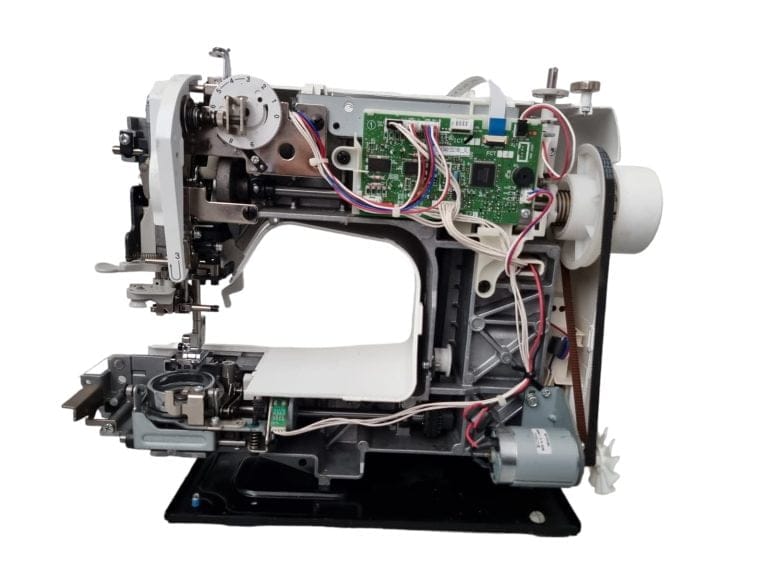
The sewing machine, for many sewing enthusiasts, is much more than just a simple tool. It is an extension of their creativity, a faithful partner in completing various projects, ranging from simple alterations to custom-made garments. But when your Singer or PFAFF acts up, it is often a thread tension issue, a stubborn hook, or a misadjusted stitch setting. You then wonder whether you should take it for repair or try the adventure of disassembling your sewing machine yourself.
This is where we come in to guide you through this delicate surgical operation.
Understanding how your machine works
The sewing machine, with its multiple parts and mechanisms, is a marvel of engineering that combines both precision and power. But to get the most out of it, it is crucial to understand how it functions.
- Importance of familiarity: Just as a musician must know their instrument to play it perfectly, a tailor must know their machine to optimize its use. The more familiar you are with each part and function of your machine, the more you will be able to handle it with ease and achieve impeccable results.
- Discovering the main parts: Each component of a sewing machine is important. From the spool holder to the shuttle, through the fabric feed mechanism, understanding the role of each part will help you anticipate your machine’s needs and react effectively in case of a problem.
- Relationship between disassembly and diagnosis: When you know how to disassemble your machine, you have access to its inner workings, which greatly facilitates detecting potential problems. Whether it is a stuck thread, a worn part, or a mechanical malfunction, disassembly is often the first step towards diagnosing and solving the problem.
Understanding your sewing machine
Before starting the operation, you must understand your patient. It’s a bit like learning anatomy before becoming a surgeon. Each machine has its specificities, and knowing them will greatly help you.
Electronic sewing machine
Is your Singer an electronic model? These machines are often more complex to disassemble, but don’t worry, we are here to guide you. The important thing here is to understand how each part interacts with the electronics. Don’t neglect the manufacturer’s manual, it may contain crucial information.
Mechanical sewing machine
Do you have a mechanical machine? These models, like Pfaff, are more traditional and sometimes easier to understand. The gears, levers, and shafts are generally more visible and accessible. Here, maintenance oil will be your best ally.
Industrial sewing machine
If you work on an industrial sewing machine, you’re in the big leagues. These machines are often more robust and designed for regular maintenance. Disassembly may seem intimidating, but once you understand the operation of the feed mechanism and the thread tension adjustment, you will be well equipped.
Common problems of a sewing machine
Every sewing machine user has probably faced some malfunctions of their tool. These problems, although sometimes frustrating, are often common and can be solved with a little patience and knowledge. Here is a list of the most frequently encountered problems with sewing machines, along with tips to identify them.
Broken thread
Possible cause: Poorly wound bobbin, dull or bent needle, inappropriate thread tension.
Solution: Check the bobbin, replace the needle, or adjust the thread tension.
Skipped stitches
Possible cause: Incorrectly inserted needle, old or incompatible with the fabric.
Solution: Ensure the needle is properly positioned and replace it if necessary. Choose a needle suitable for the fabric type.
Loop formation under the fabric
Possible cause: Incorrect upper thread tension or improperly wound bobbin.
Solution: Adjust the upper thread tension or rewind the bobbin correctly.
Fabric not feeding or feeding irregularly
Possible cause: Feed dog lowered, fabric misplaced, or inappropriate presser foot.
Solution: Check the position of the feed dogs, ensure the fabric is properly placed, or change the presser foot.
The machine makes noise or vibrates excessively
Possible cause: Machine improperly stabilized, presence of debris, or defective internal mechanisms.
Solution: Stabilize the machine, clean it, and if the problem persists, consult a professional.
The machine does not start
Possible cause: Electrical problem, blown fuse, or defective pedal.
Solution: Check the electrical connection, replace the fuse or pedal if necessary.
Difficulty turning the handwheel
Possible cause: Mechanism jammed by threads or other debris, or mechanical blockage.
Solution: Cut the power, remove stuck threads or debris, and if the problem persists, consult a professional.
Stitches are irregular or too loose
Possible cause: Inappropriate thread tension or wrong needle choice.
Solution: Adjust the tension or choose a needle suitable for your fabric.
Understand these problems by video:
Preparation before disassembly
Before disassembling your sewing machine, you must prepare your workspace and ensure you have all the necessary tools: screwdriver, pliers, maybe even a magnifying glass for the most subtle details. A good dose of patience is always recommended.
Identifying the different parts of the sewing machine, a space to place the disassembled parts, a clear view.
Don’t forget the oil, it can be a precious ally during sewing machine maintenance.
Step-by-step disassembly
Ready to get started? We begin by disassembling the steering wheel, removing the bobbin case and the fabric drive system. Then, we move on to the needle bar and the tension disc. Yes, yes, that’s a lot, but with our guide, you will never be lost.
Disassembly of the cover and bobbin mechanism
We continue with the cover and the bobbin mechanism, being careful not to misadjust the stitches. Be careful, at this stage every movement counts.
Disassembly of the needle system and arm
We now move on to the needle system and arm, making sure of the position of each piece for reassembly.
Removal of the bobbin case and motor
You are now ready to remove the bobbin case and the motor. Remember, your sewing machine is a bit like a car; each part has its place and role.
Disassembly of the motor
The crucial moment has arrived: extracting the brain of the machine. Take a deep breath, you’re almost there.
If this part is blocking, consult our guide on: How to change the motor of your sewing machine to find the necessary information.
When to call a professional?
If disassembling your sewing machine is a valuable skill for every sewer, sometimes it’s better to recognize your limits and call a professional. Here are some situations where caution and the expertise of a specialist are necessary.
- Electrical problems: If your machine has issues with starting, power variation, or other electrical problems, it is strongly recommended to consult a specialist. Electrical components require specific knowledge and incorrect handling can be dangerous.
- Complex repairs: Some breakdowns require replacement parts or adjustments beyond basic maintenance. In such cases, a professional will have the tools and expertise necessary for effective intervention.
- Lack of proper tools: If you do not have the necessary tools to disassemble or repair certain parts of the machine, it is better not to improvise. An inappropriate tool can cause more damage.
- Doubt about the procedure: If at any point you have doubts or hesitation about how to proceed, it is wise to stop and consult an expert. Better safe than sorry.
- Still under warranty: If your sewing machine is still under warranty, it is advised to contact the manufacturer or retailer for repairs. Indeed, any non-professional intervention may void this warranty.
- After several unsuccessful attempts: If despite your efforts, the problem persists or worsens, it’s time to entrust your machine to a specialist. They can accurately diagnose the fault and propose a suitable solution.
- For periodic maintenance: Even if you are comfortable with disassembly and basic cleaning, professional maintenance once a year or every two years can extend your machine’s lifespan and ensure its proper functioning.
- In case of strange noises: If your machine emits unusual sounds or vibrates excessively, it is wise to call an expert to assess the situation.
- Complete disassembly: Although some maintenance can be performed by yourself, a complete disassembly of the machine, especially for complex models, should be reserved for professionals.
In short, knowing how to disassemble and maintain your sewing machine is an undeniable advantage. However, recognizing when the intervention of an expert is necessary is just as essential to guarantee the longevity and performance of your precious work tool.
If you need advice, do not hesitate to contact our team of specialists JD Repair.